


Renal Risk Factor Brochure
A resource with information about why renal function is an important consideration when prescribing PrEP medication. Includes risk factors that may impact renal function.
This information is intended for US healthcare professionals.

(July 2012-March 2019; N=13,906)
(Hojilla JC, et al; 2021. Study used electronic health records from Integrated Health in Northern California)
*Prescriptions were filled for FTC/TDF or FTC/TAF for individuals aged ≥18 years with an indication for PrEP.1
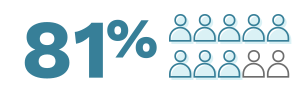
in a retrospective study analyzing EHR data of over 40,000 people prescribed oral PrEP between 01/01/2015 and 02/29/2020.3

Renal function may be declining
after age 403
~
41%
of men on a PrEP medication
are aged 40 and over4†
†Source: IQVIA® LAAD Weekly, through March 2025.‡

Actor portrayal.
‡This information is an estimate derived from the use of information under license from the following IQVIA information service: IQVIA LAAD Weekly data through March 2025. IQVIA expressly reserves all rights, including rights of copying, distribution and republication.4
Markers of renal function that can be affected by exposure to certain drugs include5:
Renal risk factors may be more prevalent than you think: 62% of oral PrEP users had ≥1 renal risk factor.3
(Retrospective US observational study, January 2015-February 2020; N=40,621)
These are some of the risk factors that may impact renal function:




A resource with information about why renal function is an important consideration when prescribing PrEP medication. Includes risk factors that may impact renal function.

People under 30 may still be building bone
and have yet
to
reach peak BMD24,25
~
25%
of men on a PrEP medication
are aged 30 and under4†

Actor portrayal.
‡This information is an estimate derived from the use of information under license from the following IQVIA information service: IQVIA LAAD Weekly data through March 2025. IQVIA expressly reserves all rights, including rights of copying, distribution and republication.4
Bone risk factors may be more prevalent than you think: 68% of oral PrEP users had ≥1 bone risk factor.3
(Retrospective US observational study, January 2015-February 2020; N=40,621)
These are some of the risk factors that may impact bone mineral density:





A resource with information about why BMD is an important consideration when prescribing PrEP medication. Includes risk factors that may impact BMD.
ADHD=attention-deficit/hyperactivity disorder; BMD=bone mineral density; CDC=Centers for Disease Control and Prevention; CKD=chronic kidney disease; DXA=dual-energy X-ray absorptiometry; eGFR=estimated glomerular filtration rate; EHR=electronic health record; ESRD=end-stage renal disease; FDA=US Food and Drug Administration; FTC/TAF=emtricitabine/

Now that you’ve learned about some of the risk factors that can impact renal function and BMD over time, there's more to explore with DESCOVY.
Select a topic:
See the difference between tenofovir alafenamide (TAF) and tenofovir disoproxil fumarate (TDF), 2 key PrEP medication components.
Learn more about HIV incidence rates with DESCOVY.
See DESCOVY seroconversion data.
Discover the impact of DESCOVY on markers of renal function.
Learn more about the impact of DESCOVY on BMD.